
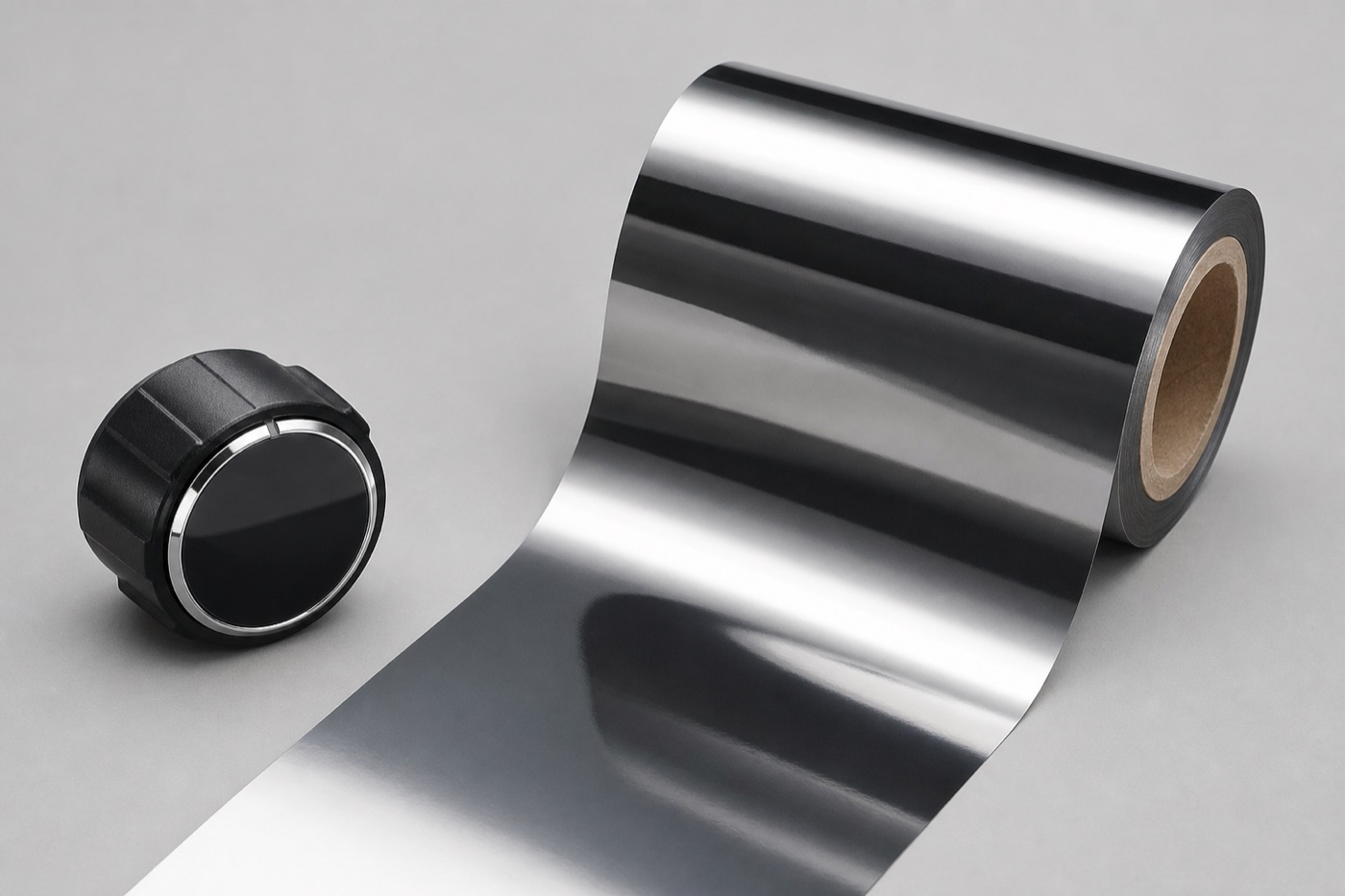
Chrome Foil
A True-Chrome Mirror Finish, Without Electroplating
Vacuum-deposited chromium replaces the aluminum layer used in standard hot stamping foil — chromium does not oxidize and is inherently corrosion-resistant, engineered to pass salt spray testing. The finish is a true chrome tone: a cool, subdued mirror consistent with electroplated chrome parts. Dry transfer, no hexavalent chromium, no electroplating wastewater — adopt it on your existing hot stamping equipment for appliance, outdoor equipment and automotive trim.
- Metal layer
- Vacuum-deposited Cr (not aluminum)
- Color range
- Bright / Satin / Dark Chrome
- Weathering tier
- L1 Indoor → L3 Automotive
- Process
- Dry stamping · electroplating-free
- Regulatory fit
- REACH hexavalent chromium (expected 2027–28)
Why Chrome Foil — the Regulatory Window on Electroplating
The EU REACH restriction on chromium trioxide — the key substance in hexavalent-chromium electroplating — continues to tighten, with full restriction expected to take effect late 2027 to early 2028. California has also set a phase-out timeline for decorative chrome plating, and a number of international brands have already stated a public shift toward chrome-free design language. For appliance and automotive parts that still need a "chrome" appearance, electroplating-free chrome-effect solutions are entering a genuine adoption-evaluation window.
| Legacy Process | Pain Point | How Chrome Foil Responds |
|---|---|---|
| Hexavalent Chrome Electroplating | REACH/CARB compliance deadlines approaching; high wastewater treatment cost; trivalent-chrome alternatives skew yellow | No hexavalent chromium and no electroplating wastewater anywhere in the process; color is not affected by plating-bath drift |
| PVD / NCVM | High capital equipment cost; deep recesses can't be coated; batch-mode throughput | Stamping equipment investment an order of magnitude lower; free choice of localized decoration; fast continuous production cadence |
| Chrome-Effect Spray Coating | Weaker weathering and abrasion resistance; metallic pigment orientation hard to control | Vacuum-deposited chrome mirror layer gives more uniform, higher-grade mirror finish than pigment spray |
| Stainless Steel / Die-Cast Parts | Weight, cost and forming freedom constraints | Plastic parts stay lightweight with full design freedom, while reaching a metal-like appearance |
Six-Layer Structure — Chrome in Place of Aluminum Is the Fundamental Difference
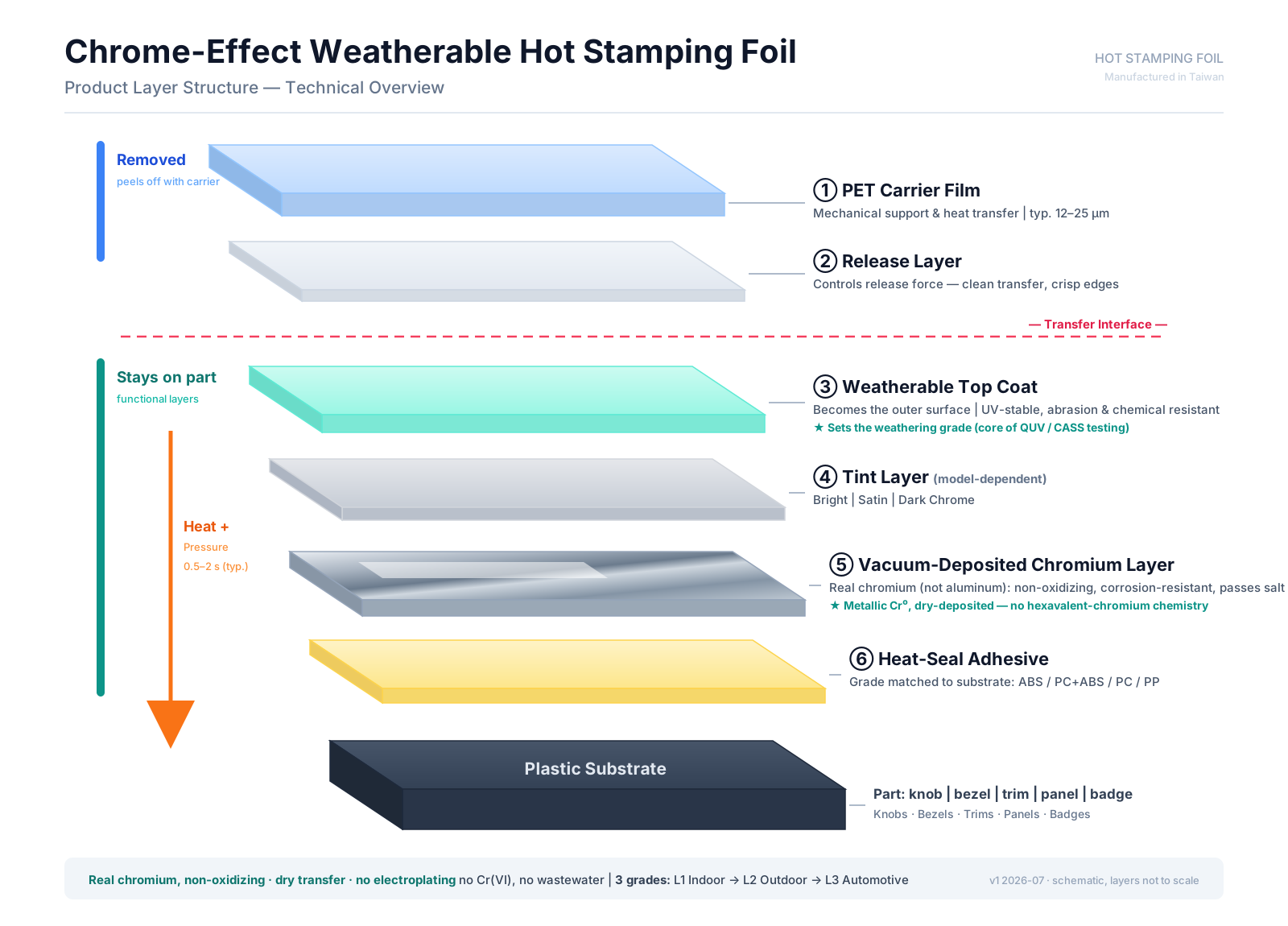
Layer ⑤, the vacuum-deposited chromium mirror layer, is the core of the product: an aluminum layer loses its shine when exposed to moisture or salt through oxidation; metallic chromium does not oxidize and is inherently corrosion-resistant — this is why the product can target salt spray test compliance and hold up on outdoor and long-service surfaces. The color is correspondingly a "true chrome" tone: more subdued and cooler than aluminum, matching electroplated chrome parts side by side.
Layer ③, the weatherable top coat, is the second line of defense: it becomes the product's outermost surface after transfer, and a UV-resistant system (UV absorbers plus light stabilizers) suppresses yellowing and gloss loss, while a high cross-link density governs abrasion and chemical resistance.
Layer ④, the tint layer, sets the hue: standard bright chrome, satin chrome, gunmetal/dark chrome — retro-style small appliances mostly specify a true bright-chrome tone, while dark/gunmetal chrome demand is rising in automotive design language.
| Item | Standard Decorative Hot Stamping Foil | Chrome-Effect Weatherable Foil |
|---|---|---|
| Metal layer | Vacuum-metallized aluminum (loses shine to oxidation in humid/salt environments) | Vacuum-deposited chromium (non-oxidizing, inherently corrosion-resistant, targets salt-spray pass as a design goal) |
| Metallic tone | Bright white-silver (aluminum color) | True chrome tone: a cool, subdued mirror matching electroplated chrome parts |
| Top coat | General abrasion resistance is sufficient | UV-resistant, highly cross-linked weatherable system |
| Validation baseline | Appearance plus basic adhesion | Full QUV/xenon-arc weathering, CASS, and damp-heat cycling framework |
| Target use | Packaging, indoor small parts | Appliance long-service surfaces, outdoor equipment, automotive |
Three Weathering Tiers
Selection is grouped into three tiers by end-use environment, each mapped to a different top-coat system and validation intensity:
Indoor Appliance Grade
Control knobs, panel bezels, logo nameplates and other indoor long-service surfaces — resistant to cleaning agents, hand-grease residue and daily abrasion.
Outdoor Equipment Grade
BBQ grill knob rings, patio heater trim, garden-equipment emblems — UV resistance and salt-spray tolerance are the design focus.
Automotive Grade
Interior button rings and trim strips, emblems; exterior parts are adopted after completing validation to the relevant OEM specification (xenon-arc SAE J2527, etc.).
Target Applications — Appliances and Automotive as the Main Fronts
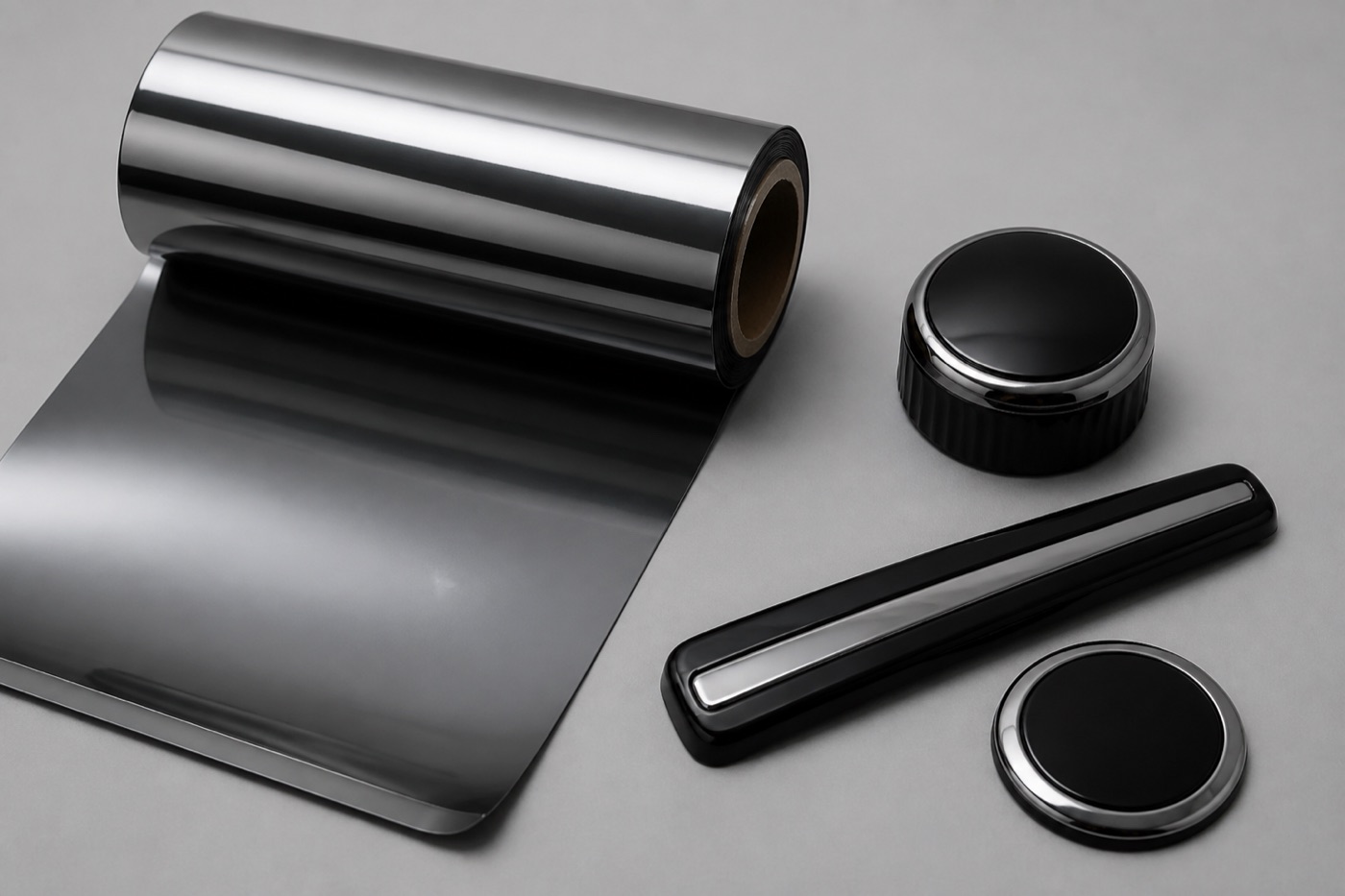
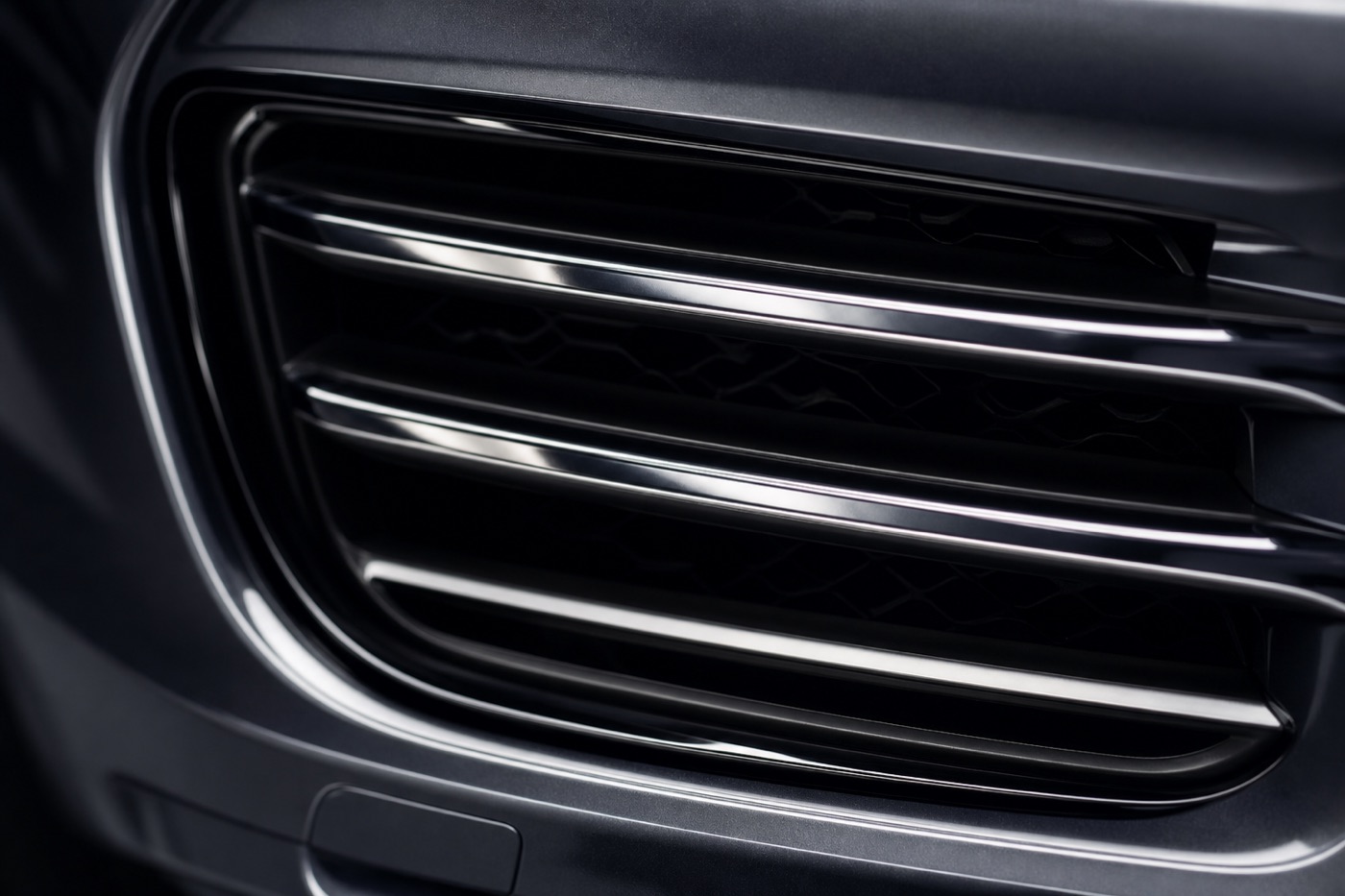
Design language reference: bright-chrome trim on retro small appliances (kettles, toasters, stand mixers) accounts for the bulk of demand; in automotive, dark-chrome and satin-chrome demand is rising. Hot stamping is limited to flat–2.5D part geometry — for deep 3D contours, evaluate alternative processes such as IMD instead.
Stamping Process Guide — Adopt It on Equipment You Already Have
| Stamping Method | Suited Part Geometry | Notes |
|---|---|---|
| Flat-Bed Stamping | Flat / slightly curved: nameplates, panels, trim pieces | Metal-etched die (brass/magnesium/steel) or silicone die |
| Silicone-Die Stamping | 2.5D contours: knob tops, curved trim rings | Silicone hardness and die-face conformity determine transfer uniformity |
| Roller Stamping | Long trim strips, cylindrical sides, large areas | Continuous roll-to-roll pressing, suited to appliance door handles and long trim |
| Peripheral Stamping | Knob side rings, cap/lid sides | Part rotates to match the stamping motion |
Verification Framework and Quality System
| Verification Item | Method | Notes |
|---|---|---|
| Adhesion | ASTM D3359 / ISO 2409 cross-hatch | Adhesion grade per substrate, targeting 5B/0 |
| Accelerated Weathering | QUV ASTM G154 / Xenon G155 · SAE J2412/J2527 | ΔE, gloss retention and post-aging adhesion |
| Salt Spray | CASS ASTM B368 / NSS ASTM B117 | Metallic chromium layer targets a salt-spray pass as a design goal |
| Chemical Resistance | Per OEM/customer specification | Household cleaners, alcohol, sunscreen, etc. |
| Damp-Heat Cycling | Per customer specification (e.g. −40↔85°C) | Appearance and adhesion after cycling |
Our data disclosure policy: this page describes the product's structure, stamping methods and verification framework; full third-party test reports are in preparation and will be provided proactively once issued. In the meantime you can request the product data sheet (EN, PDF) and a sample card for evaluation. The manufacturer operates an ISO 9001 quality management system, with retained samples traceable by batch number.
Frequently Asked Questions
How is chrome foil different from standard hot stamping foil?
The metal layer: standard hot stamping foil is vacuum-metallized aluminum (loses shine to oxidation). This product replaces it with vacuum-deposited metallic chromium — non-oxidizing, inherently corrosion-resistant, with a color that matches electroplated chrome parts in a cool, subdued mirror finish.
Does it use hexavalent chromium? Is it subject to REACH restrictions?
No. Vacuum deposition applies "metallic chromium (Cr)" — a dry physical process — without any hexavalent chromium chemicals. REACH restricts hexavalent chromium substances such as chromium trioxide used in electroplating; that is a separate matter from the metallic chromium film.
What equipment is needed?
Standard hot stamping equipment is sufficient (flat-bed / silicone die / roller / peripheral) — converters that already run a hot stamping line need no new equipment; adopt it after a trial run against the parameter card.
What part geometries is it suited to?
Flat to 2.5D: knobs, trim strips, decorative rings, nameplates, emblems, panel bezels. For deep 3D contours, evaluate alternative processes such as IMD instead — confirm part geometry at the selection stage.
Is there real-world weathering and salt-spray test data?
The verification framework is built on QUV/CASS/NSS/cross-hatch adhesion and similar standard methods, with the metallic chromium layer targeting a salt-spray pass as a design goal. Full third-party reports are in preparation and will be provided proactively once issued; you can request the data sheet and a sample card now.
How does this relate to the rest of the hot stamping foil range?
This product is a weatherable, specialized series within the hot stamping foil family; for general decorative use, see our standard hot stamping foil range.
Evaluating chrome foil for your application?
Tell us your part geometry (flat / 2.5D), substrate and end-use environment (indoor / outdoor / automotive), and we'll help confirm the weathering tier and stamping parameters, with a sample card and product data sheet.