 LIHYANG FOIL TECHNOLOGY
LIHYANG FOIL TECHNOLOGY
LIHYANG FOIL TECHNOLOGY
R2R Vacuum Coating Process · Specifications · Applications · vs. Traditional Aluminium Foil
AlOx (Aluminum Oxide, Al₂O₃) is an inorganic ceramic material widely used in precision ceramics, semiconductors, and thin-film barrier technology. Unlike metallic aluminium, Al₂O₃ is non-conductive and does not trigger metal detectors — its most critical advantage for food packaging applications.
AlOx barrier film is manufactured using a Roll-to-Roll (R2R) continuous reactive vacuum evaporation process. The PET web travels at high speed (typically 400–600 m/min) through a high-vacuum chamber (10⁻⁴ – 10⁻⁵ mbar). Aluminium metal (Al) is evaporated from resistively heated ceramic boat sources, while reactive oxygen gas (O₂) is simultaneously injected towards the film surface. The aluminium vapour reacts with O₂ at the substrate surface to form a dense Al₂O₃ ceramic coating — a process known as reactive evaporation. This is the dominant commercial technology for transparent barrier film production worldwide. The resulting coating is only 20–50 nm thick — negligible weight addition — yet delivers gas barrier performance approaching metallic aluminium foil.
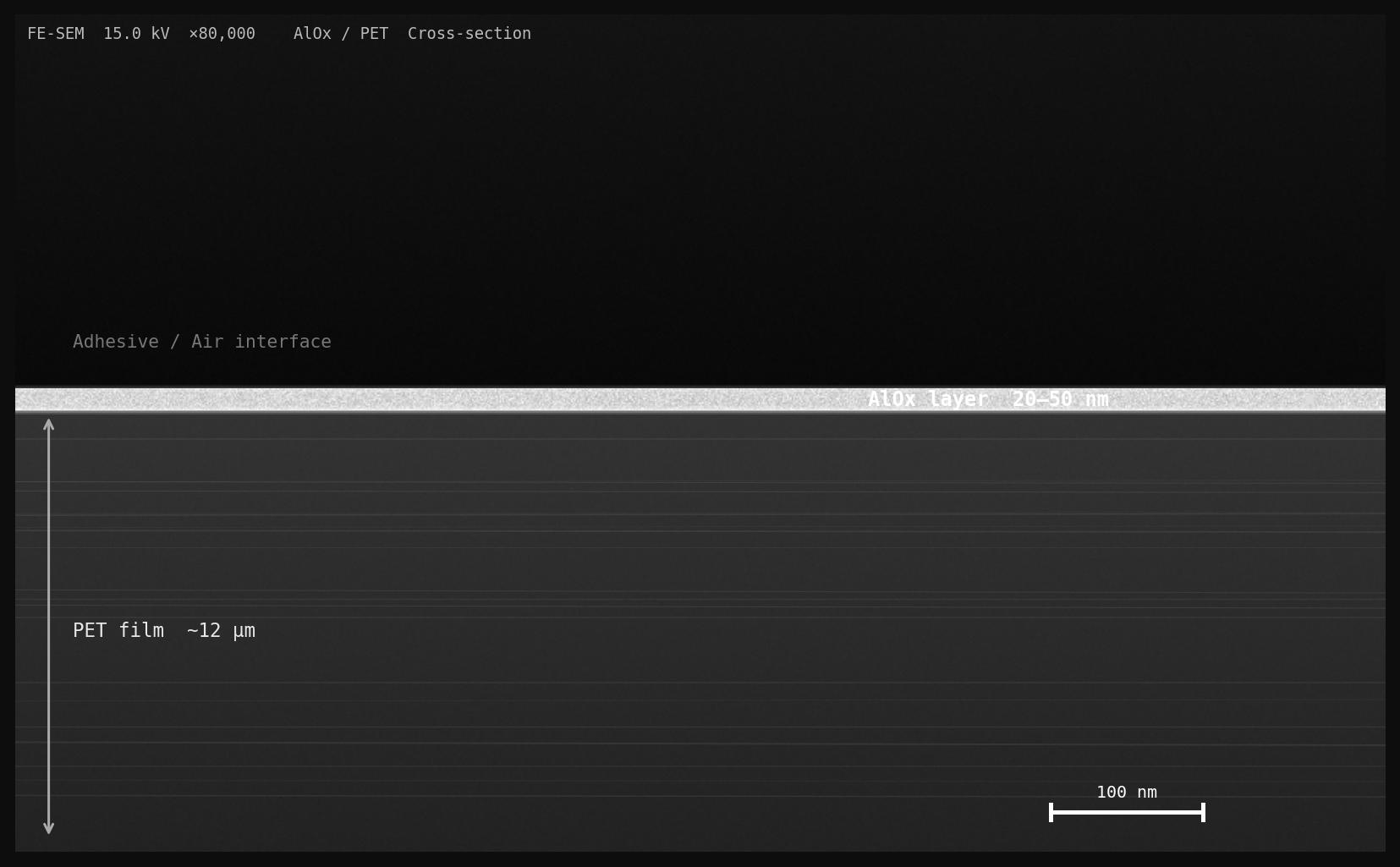
The barrier mechanism of AlOx film derives from the dense, pinhole-minimized structure of the ceramic layer. O₂ and H₂O molecules cannot penetrate the tightly packed Al₂O₃ lattice and must circumnavigate the rare defects (pinholes), dramatically extending the gas diffusion path. By comparison, uncoated PET has an OTR of ~100–150 cc/m²/day; after AlOx coating this drops to ≤1.0 — a barrier improvement exceeding 100×.
When selecting barrier packaging materials, the following three are most commonly compared. Each has its optimal use case — understanding the differences helps select the right solution for your production line.
| Property | Aluminium Foil | Metallized Film (VMPET) | AlOx Barrier Film |
|---|---|---|---|
| Appearance | Opaque silver | Opaque metallic silver | Transparent (>90% light transmission) |
| Coating Material | Metallic Al | Metallic Al ~40 nm | Al₂O₃ ceramic, 20–50 nm |
| Total Thickness | 6–20 µm | PET (12–19 µm) + Al layer | PET (12–19 µm) + AlOx layer |
| OTR (23°C, 0%RH) | ≈0 (near-total barrier) | ≤1.5 cc/m²/day | ≤1.0 cc/m²/day |
| WVTR (38°C, 90%RH) | ≈0 | ≤1.0 g/m²/day | ≤1.0 g/m²/day |
| Metal Detector | ❌ Fails | ❌ Fails | ✓ Passes |
| Microwavable | ❌ No | ❌ No | ✓ Yes |
| Product Visibility | ❌ Opaque | ❌ Opaque | ✓ Transparent |
| Relative Cost | High | Medium | Med-High (precision) |
| Food Contact Safety | ✓ Compliant | ✓ Compliant | ✓ Compliant |
* OTR and WVTR values vary by test conditions and coating thickness. Contact Lihyang engineers for custom barrier specifications.
Lihyang supplies both Metallized Film (VMPET) and AlOx Transparent Barrier Film. Barrier performance is close (VMPET OTR ≤1.5 cc/m²/day; AlOx OTR ≤1.0 cc/m²/day — both are vacuum-deposited coatings), but the right choice depends on your application. Here is an honest breakdown:
In short: both films deliver comparable barrier numbers — AlOx wins on transparency, metal-detector compatibility, and microwave safety; VMPET wins on established processing and cost. Not sure which fits your line? Email tw@lihyangfoil.com with your application and our engineers will help you decide.
The three-in-one characteristics of AlOx barrier film — high barrier + transparency + metal detector compatibility — give it irreplaceable advantages in the following three sectors:
Coffee drip bags, tea bags, snack packaging, agricultural seed bags. Transparent appearance lets consumers see the product, while high barrier prevents oxidation and moisture, extending shelf life. Metal detectors on automated lines operate normally without material substitution.
Blister packs, medicament sachets, medical device desiccant pouches, infection control packaging. AlOx film complies with EU and FDA food/pharma contact regulations. WVTR ≤1.0 at 38°C/90%RH effectively protects pharmaceutical shelf life.
PCB protective bags, LED driver shipping packaging, semiconductor component storage. AlOx film maintains stable WVTR ≤1.0 during long-term ambient storage, preventing oxidation before installation.
| Parameter | Standard | High-Barrier | Test Method |
|---|---|---|---|
| Coating Material | Al₂O₃ (Aluminum Oxide) | — | |
| Coating Thickness | 30–40 nm | 45–50 nm | TEM / SEM |
| Base Film | PET 12 / 15 / 19 µm | — | |
| Light Transmission | >90% | ASTM D1003 | |
| Oxygen Transmission Rate (OTR) | ≤1.0 cc/m²/day | ≤0.5 cc/m²/day | ASTM D3985 (23°C, 0% RH) |
| Water Vapour Transmission Rate (WVTR) | ≤1.0 g/m²/day | ≤0.5 g/m²/day | ASTM F1249 (38°C, 90% RH) |
| Tensile Strength (MD/TD) | ≥150 / ≥200 MPa | ASTM D882 | |
| Elongation at Break (MD/TD) | ≥100 / ≥80% | ASTM D882 | |
| Metal Detector Compatible | Yes ✓ | — | |
| Microwavable | Yes ✓ | — | |
| Available Width | 500–1600 mm | — | |
| Max Roll Length | 5,000–10,000 m | — | |
| Minimum Order Quantity (MOQ) | 1 roll (stock spec) | — | |
* Above specifications are reference values for standard products. Actual values per custom spec and batch test reports. For custom barrier specs, laminate structures, or printed versions, contact Lihyang's application engineers.
AlOx barrier film uses Roll-to-Roll (R2R) reactive vacuum evaporation to deposit a 20–50 nm aluminum oxide (Al₂O₃) ceramic layer on PET substrate. Since Al₂O₃ is a ceramic oxide rather than metallic aluminium, the film is highly transparent (>90%), passes metal detectors, and is microwavable. By contrast, metallized film (VMPET) contains metallic aluminium — opaque silver in appearance and incompatible with metal detectors. Both offer similar barrier performance, but AlOx has clear advantages in transparency and processing compatibility.
Lihyang standard AlOx: OTR ≤1.0 cc/m²/day (ASTM D3985, 23°C/0%RH); WVTR ≤1.0 g/m²/day (ASTM F1249, 38°C/90%RH). High-barrier versions achieve OTR ≤0.5, WVTR ≤0.5. Compared to uncoated PET (OTR ~120 cc/m²/day), barrier improvement exceeds 100×. For full TDS datasheets or custom specs, email tw@lihyangfoil.com.
Yes. Metal detectors detect electrically conductive metallic materials. AlOx coating is aluminum oxide (Al₂O₃) — a non-conductive ceramic oxide containing no free metallic aluminium — so it does not trigger metal detector sensors. This allows AlOx film to be used seamlessly on fully automated food packaging lines equipped with metal foreign-object screening.
AlOx film can be laminated with: CPP (cast polypropylene, common food packaging), LLDPE (linear low-density PE, impact resistant), BOPP (biaxially oriented PP, clear high-gloss). Use two-component PU adhesive; avoid acidic adhesives that may react with the oxide layer. The AlOx coated face should ideally be sandwiched in the structure (e.g. PET-AlOx / adhesive / CPP) to protect the coating from abrasion during downstream processing.
To request free samples: ① Fill the website inquiry form with your application and spec requirements; ② Email tw@lihyangfoil.com with your end application (food/pharma/electronics), required width (mm), and estimated annual volume. MOQ: Standard products: 1 roll (~5,000–10,000 m depending on width). Lead time: In-stock specs: 3–5 business days; custom width or special barrier specs: 15–20 business days.
Lihyang Foil Technology provides free technical samples of AlOx barrier film, TDS datasheets, and engineer consultation. Share your application and we'll recommend the optimal specification.
RELATED PRODUCTS & ARTICLES
© 2026 Lihyang Foil Technology Co., Ltd. — Hot Stamping Foil · Metallized Film · AlOx Barrier Film Manufacturer